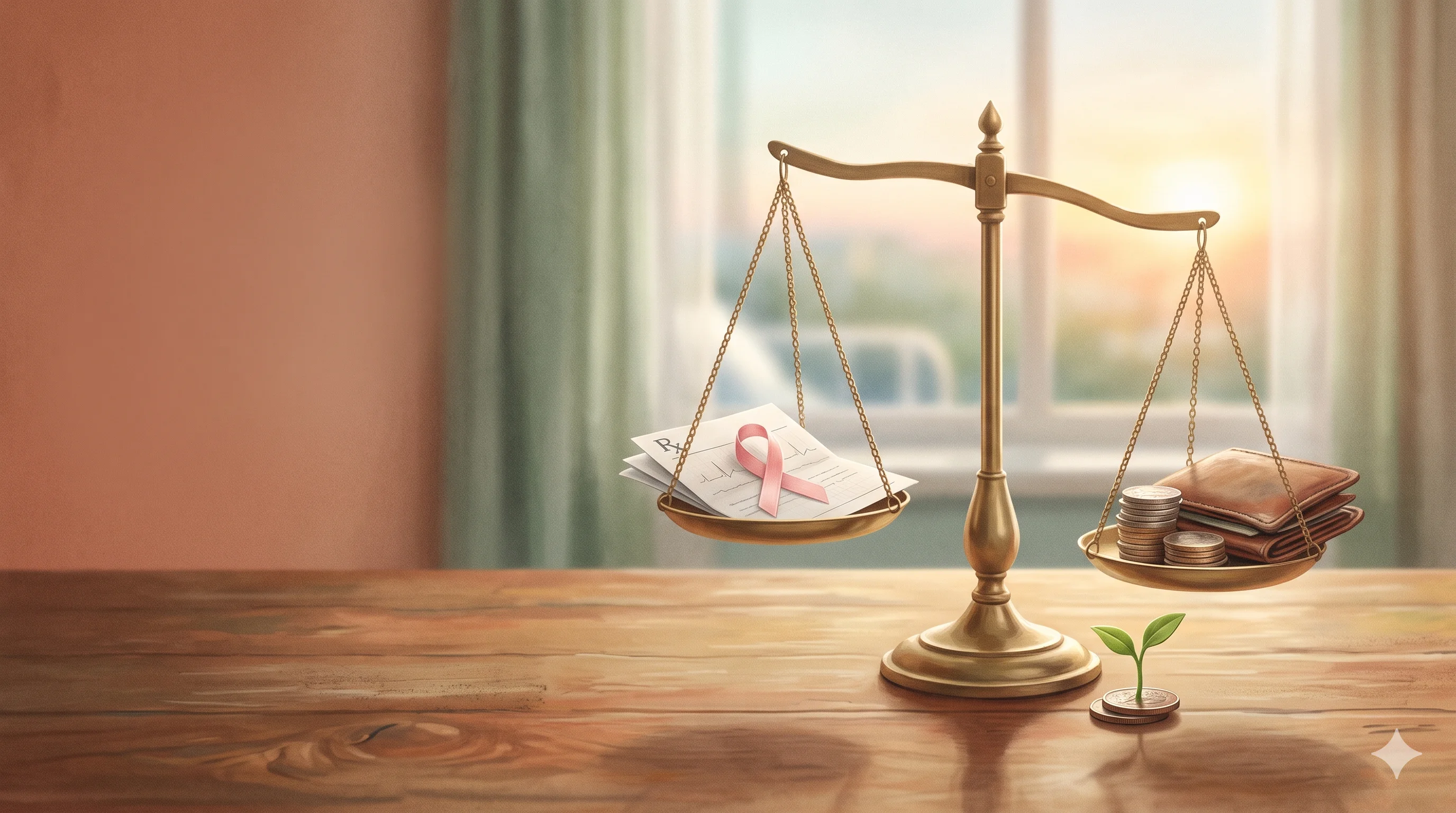
There is a specific kind of silence that fills a room when a doctor uses the word "cancer" about your mother. I write here about spreadsheets, withdrawal rates, and the cold mathematics of becoming financially independent. I thought I had stress-tested my life against every possible disaster. Then, in May of 2026, a pathology report turned all of that abstraction into something terrifyingly real.
This post is the one I never wanted to write. It is about my mom's cancer diagnosis, the catastrophic mistake we made by not having health insurance, and the actual dollar cost of treating cancer when you are paying for every single rupee out of your own pocket. If you have been telling yourself you will "get around to" insurance for your parents someday, I am begging you to read this and then go do it today.
The Diagnosis No One Saw Coming
It started, as these things often do, with something that looked like nothing. A lump. The first biopsy came back benign. We were relieved. She took a course of antibiotics, the lump shrank, and we exhaled.
But it didn't fully go away. Her gynecologist, to her enormous credit, refused to let it slide. She advised excising the lump entirely and re-testing it. That decision saved my mother's life. The excision revealed what the first test had missed: triple-negative breast cancer. The first result had been a false negative — but we moved fast, and it never cost us any time.
It was caught early, with no sign that it had spread. I will be honest about my own cowardice here: when the pathology report arrived, I could not open it. I sat with that unopened file and told myself I simply did not have the courage to read it yet. Her gynecologist's reaction was less gentle and exactly what we needed: "Go aggressive. Use as many options as you have."
We did. At Sahyadri Hospital in Pune, under the care of Dr. Shona Nag, the plan came together: chemotherapy combined with immunotherapy first, then surgery, then radiation, then a year of follow-up immunotherapy. When the PET-CT came back showing no spread and the oncologist used the word "definitely curable," it was the first full breath I had taken in a week. As I write this, she is in active chemotherapy, tolerating it with almost no side effects. Her hemoglobin is actually rising. We got lucky in every way except one.
The One Way We Were Not Lucky: There Was No Insurance
Here is the part that keeps me up at night. We did not have a gap in coverage. We did not have a policy with a low limit or a cruel exclusion buried in the fine print.
There was simply no health insurance at all.
Not because we couldn't afford it. Not because we were denied. For the most embarrassing, preventable reason imaginable: we never took it seriously. It was always the thing for next month, next quarter, after the next milestone. My mother was healthy. I was busy. The premium felt like money spent on a problem we didn't have. So we never bought the policy.
Then, in a moment of panic, we tried to fix it the wrong way. Within two or three days of getting the first reports back, we applied for health insurance. And remember — at that exact point, the first biopsy had come back benign. On paper, she was a healthy applicant with a clean recent test.
We were rejected anyway.
That is the lesson seared into me forever: the moment you need insurance is the exact moment you can no longer buy it. Insurance is a bet you place when you are healthy, on a future you hope never arrives. The instant there is a single finding in your file — even one labeled benign — that window slams shut. We tried to run through a door that had already closed days earlier, and we never even heard it shut.
What Cancer Actually Costs
So we are paying. All of it. Out of my own savings. Let me give you the real numbers, because vague hand-waving about medical bills helps no one. (All conversions at roughly ₹94 to the US dollar.)
| Line item | Approximate cost |
|---|---|
| Chemotherapy (per cycle) | ~₹47,000 (~$500) |
| Immunotherapy — pembrolizumab (per dose) | ~₹1.6 lakh (~$1,700) |
| Surgery, radiation, scans, hospital stays, travel & lodging | folded into the total below |
| Total projected course of treatment | $17,000 – $20,000 |
A few things worth knowing if you ever find yourself here. The single most expensive component is the immunotherapy — pembrolizumab (Keytruda). We were able to roughly halve that cost through the Kiran / Keytruda patient assistance program, which offers a buy-one-get-one arrangement on doses. If you or a family member are ever prescribed this drug, ask about that program before you pay a single bill. It is the difference of many thousands of dollars over a full course.
The protocol itself (a KEYNOTE-522-style regimen: weekly chemotherapy plus pembrolizumab, then a second chemo combination, then surgery and radiation, then about a year of immunotherapy) stretches across roughly six months of active treatment and a year of follow-up. Every one of those line items is a payment. There is no monthly statement from an insurer absorbing the blow. It is just you, your savings, and a hospital billing desk.
What This Did to My Financial Plan
People who follow FIRE obsess over the question: what happens when reality finally tests the spreadsheet? This was my test.
I am deliberately not going to talk in absolute dollar figures here, because the numbers that matter are the ratios. In a normal year, my planned spending runs at roughly 1.85% of my portfolio — a comfortably low withdrawal rate, well under the classic 4% rule. This year, funding my mom's treatment entirely out of pocket pushes that to about 2.76%.
In other words: a full-blown, uninsured cancer treatment for a parent registered as a one-time bump of roughly 0.9 percentage points in my withdrawal rate. It did not break the plan. It barely bent it.
I want to be very clear about why that is, because it is the whole point. It is not because cancer is cheap — it manifestly is not. It is because I had built a large enough buffer that I could absorb a five-figure shock without selling my future. The buffer was my insurance. I had unknowingly self-insured by accident, through years of saving, and I am painfully aware that almost no one else has that luxury. If this same bill had landed on a normal household budget, it would not have been a 0.9% blip. It would have been a mortgage refinanced, a retirement emptied, a family put into debt for a decade.
That is the quiet violence of being uninsured: the bill is the same for everyone, but the damage it does scales inversely with how much you've saved. The people least able to afford catastrophe are the ones who get hit hardest by it.
What I Want You To Actually Do
The lesson section of every other post I write is usually a nuanced "it depends." Not this one. This one is simple and I will not soften it.
-
Buy health insurance for your parents while they are healthy. Today. Not after you read this. Not this weekend. The single most valuable property of insurance is that it must be purchased before you have any reason to want it. A clean medical history is the most perishable asset you own.
-
Buy it for yourself, too, even if you feel invincible. Especially if you feel invincible. The version of you that needs it cannot buy it.
-
A single benign finding can make you uninsurable. Do not wait for "results" before applying. We applied on a clean report and were still rejected. The bureaucracy does not care about your intentions; it cares about timestamps.
-
If you are pursuing financial independence, model a catastrophic health event explicitly into your plan. Not a vague "emergency fund," but a real, named line: what happens to my withdrawal rate if I have to fund a $20,000 medical bill out of pocket this year? If the answer wrecks you, your plan is thinner than you think. Self-insurance is real, but it only works if the buffer is actually there.
My mother is going to be okay. The oncologist says curable, the scans agree, and she is stronger through chemo than I had any right to hope. We were lucky — lucky in the diagnosis, lucky in the doctors, lucky that I had the savings to make the lack of insurance survivable.
But luck is not a financial plan. Insurance is. Please do not learn this the way we did.